
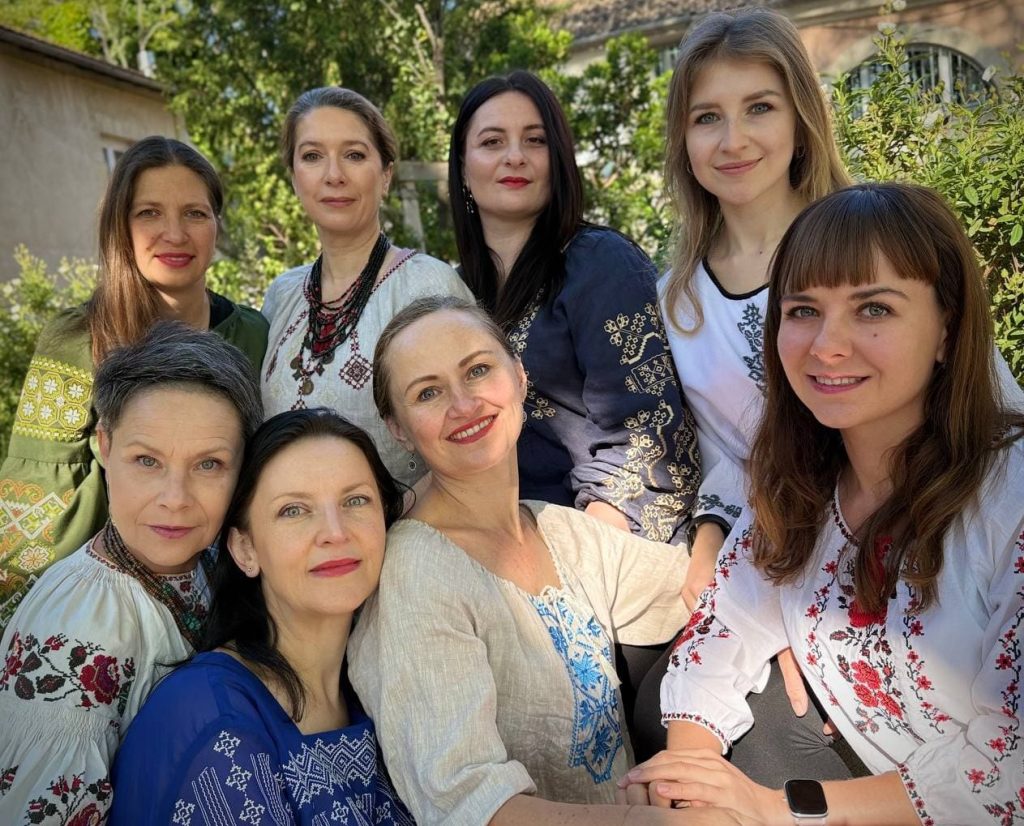

The Ukrainian vyshyvanka is not merely an embroidered shirt. It is a garment steeped in history, a sign of belonging and a symbol that has endured through the centuries without losing its significance. In its threads, colours and patterns, one can trace the history of Ukraine, its regions, its beliefs and the way in which it preserves its identity through textiles.
Even today, it is far from being a relic of the past. The vyshyvanka continues to thrive at festivals, ceremonies, cultural gatherings and in contemporary fashion.
Ancient origins
The history of the vyshyvanka goes back a very long way. Sources point to ancient roots, linked to the textile traditions of the peoples who lived in what is now Ukraine, particularly during the Scythian period and later in the era of Kievan Rus’. Originally, the embroidery served more than just a decorative purpose. It also served as symbolic protection, particularly on the parts of the garment considered most exposed, such as the collar, cuffs and shoulders.
This protective role has left a lasting mark on Ukrainian culture. The embroidered shirt has thus become an item that is both practical and beautiful, and rich in meaning.
An identity that varies from region to region
What makes the vyshyvanka so fascinating is that it has never been uniform. From one region to another, the patterns, colours and techniques vary enormously. Each region has developed its own visual language, giving the vyshyvanka a remarkable diversity.
In the west, particularly in the Carpathians and Transcarpathia, embroidery is often more flamboyant, denser and more colourful. It features rich compositions, floral and geometric patterns, and striking contrasts. In central Ukraine, the designs are often more balanced, with simpler yet equally elegant forms.
The Poltava region is known for its finer, more subtle embroidery, sometimes done in white on white. In Kyiv and the surrounding areas, the patterns often combine plant motifs and geometric shapes, in colours such as red, black, blue or white. Further south and east, local traditions give rise to other variations, sometimes more contrasting, sometimes closer to a rural or narrative aesthetic.
The vyshyvanka is almost like a textile map of Ukraine: through it, one can discern a region, a local history and a distinctive taste for colour and symbolism.
From everyday clothing to a national symbol
For a long time, the vyshyvanka was part of everyday life. It was worn for work, for celebrations, for weddings, or to mark life’s major milestones. Then, with the political and social upheavals of the 20th century, it was sometimes relegated to the status of a rural or folkloric tradition.
But it has regained a central place in independent Ukraine. Today, it is worn as a symbol of identity, continuity and cultural pride. For many, putting on a vyshyvanka is a way of affirming a connection to their family, their region and their country.
A very contemporary presence
The vyshyvanka is not just a thing of the past. It has also found its place in the present. It can be seen at official events, concerts, weddings, photo shoots and fashion shows, as well as in contemporary fashion, where it inspires Ukrainian and international designers.
This enduring appeal is no doubt due to its versatility. It can be traditional or contemporary, understated or spectacular, heritage-inspired or cutting-edge. But in any case, it retains that visual impact that makes it instantly recognisable.
Vyshyvanka Day
Every year, the vyshyvanka is celebrated on World Vyshyvanka Day, held on the third Thursday in May. In 2026, it falls on 21 May. This day was established in the 2000s on the initiative of students from Chernivtsi, who wanted to dedicate a day to this iconic garment.
The idea quickly gained momentum. Today, the celebration brings together Ukrainians in Ukraine and across the diaspora through concerts, exhibitions, gatherings and symbolic gestures of solidarity. In times of war, the significance of this day is even greater, as it also serves as a time for remembrance, unity and cultural support.
A symbol that lives on
The Ukrainian vyshyvanka is a unique garment: it is at once ancient and contemporary, local and universal, intimate and public. It bears the marks of regions, families, traditional craft techniques and collective histories. This is undoubtedly why it continues to fascinate people far beyond Ukraine’s borders.
It does not merely recall the past. It transforms it into a living presence, carried on people’s shoulders, through the streets, at festivals and in our shared memory.