
The Motanka is one of the oldest and most spiritual symbols of Ukrainian culture. Much more than a simple decorative object, this handmade doll embodies protection, transmission and the bond between generations. Steeped in meaning and tradition, it occupies a special place in Ukrainian folk heritage.
Origins and history
Motanka has its origins in Slavic pagan traditions, long before the Christian era. Its name comes from the Ukrainian verb ‘motaty’, which means ‘to roll up’, referring to the technique of making it without sewing or needles.
Originally, these dolls were created as protective talismans. They were made by the women of the family to attract prosperity, protect the home or accompany important events such as a birth, a wedding or a departure.
A key distinguishing feature:
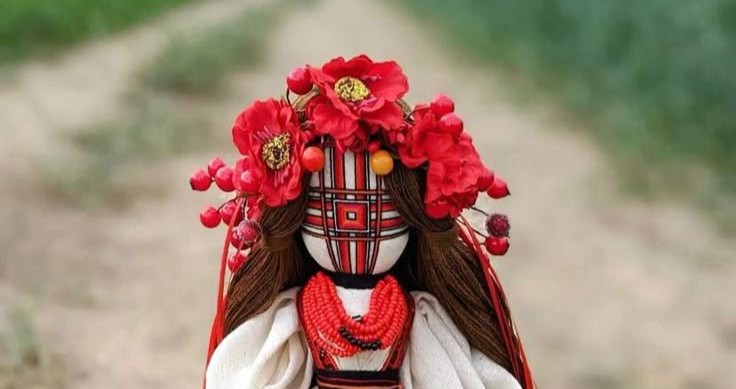
◆Motanka has no face
This absence is not an oversight, but a belief. It was believed that a face could allow a spirit to enter the doll. Instead, a cross of coloured threads is often formed on the head, symbolising light, harmony and balance.
Each Motanka had a specific function:
◆ Home protection
◆ Fertility
◆ Marital bliss
◆ Children's health
Characteristics of the Motanka
The Motanka is distinguished by several typical features:
Needle-free manufacturing
The fabrics are knotted, rolled and folded by hand. This symbolises the continuity of life without “piercing” the energy.
Absence of a face
She represents a universal figure rather than a specific individual.
Symbolic cross on the head
Often made of red, yellow or blue threads, it evokes sun protection.
Traditional clothing
The dolls wear clothes inspired by Ukrainian traditional dress:
◆ Embroidered shirts (vyshyvanka)
◆ Skirts or aprons
◆ Scarves
◆ Woven belts
Natural materials
Linen, cotton, wool – in harmony with nature and purity.
Every detail has meaning: colours, knots, number of layers of fabric...
The cultural significance
Motanka is deeply rooted in Ukrainian symbolism.
Protection and positive energy
She is seen as the guardian of the home.
Passing on traditions
Making a Motanka is a cultural and family activity.
Life cycle
Some dolls represent motherhood, others represent ancestors.
Spiritual connection
She embodies harmony between humans, nature and the invisible world.
For centuries, it has accompanied Ukrainians in their daily lives, serving as a good luck charm and symbol of identity, especially in times of hardship.
Motanka today
Today, Motanka is experiencing a remarkable revival.
Craft and heritage object
It is present at fairs, museums and cultural exhibitions.
Symbol of national identity
It represents roots, resilience and collective memory.
Contemporary creations
Artists are revisiting the Motanka with modern styles while respecting traditional codes.
Symbolic gift
It is often given as a good luck charm or cultural souvenir.
In a globalised world, the Motanka remains a powerful reminder of the importance of traditions, craftsmanship and ancestral spirituality.
The Motanka is not just a doll.
It is a living memory, protection and heritage of Ukraine.